 2 hours ago
Warners winning
It was always going to be a banner Oscars year for Warner Bros, leading the race with the two major films of the season – Sinners and One Battle After Another – the perfect end to a perfect year of critical and commercial hits for the studio. But with 11 wins tonight, by far the biggest tally for any company, the evening really did serve as a reminder of how much Warners has achieved in its year of greenlighting dangerously, at least at this risk-averse time. It couldn’t come at a more depressing intersection for the studio as it prepares to fall under the ownership of Paramount-Skydance and the Ellisons, its future looking unsure. Paramount might have been a major contender back in the day with best picture winners including The Godfather, Ordinary People and Forrest Gump, but its been mostly absent of late, bar Top Gun: Maverick. Hard to imagine the studio which now relies almost exclusively on reanimating rusty IP will care much about auteurs and awards. Benjamin Lee
Conan pitches for lifetime appointment
If Conan O’Brien is one thing, it is game: down to be the butt of the joke, to commit fully to an inane bit, to try harder and do more than anyone for a laugh. Look no further than his opening pre-taped segment this year, in which donned Weapons-style clown makeup and flailed about the (slickly edited) sets of several movies while chased by a horde of children. The comedian’s second outing as Oscars host was a step up from his solid start last year: looser, sillier, more confident, deftly threading the needle between politically aware and good-natured, and never without an obvious appreciation for the art of movies and jokes. A mid-show appearance by former long-time host Jimmy Kimmel to present the documentary awards served only to underscore how much better suited Conan is for this job; Kimmel, with his pointed and gratuitous jabs at a president who will always take the bait and stays the center of attention, may be right, but he is not nearly as fun. A post-show bit riffing on Sean Penn’s fate in One Battle After Another facetiously proclaimed Conan “Oscars host for life” for a punchline. But I think that, unlike him, we should take this seriously: please, make this a permanent appointment. Adrian Horton
Chalamet-ed out
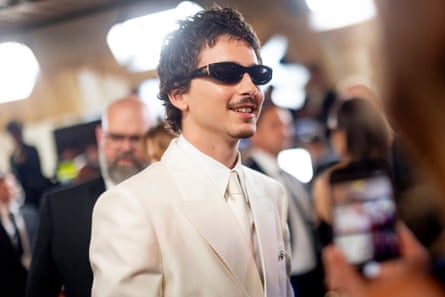
It’s odd that even at the age of 30, people had been claiming it was finally Timothée Chalamet’s time to win an Oscar. It wasn’t just that the actor had been nominated twice before, for Call Me by Your Name and A Complete Unknown or had starred in contenders such as the Dune films, Lady Bird and Little Women, but he had just been so very present throughout each campaign, increasingly inescapable and doing the one thing actors aren’t supposed to do: admit that he really wanted to win. His all-guns-blazing performance in Marty Supreme was rightly acclaimed by all, and as the film became a surprise box office hit over Christmas, it seemed like it was his to lose. But the line between his obnoxious character and the actor himself started to blur as press tour turned into awards tour and we reached the umpteenth month of the longest Oscar season on record, and the more voters saw and heard from him, the less likely his win became, with Michael B Jordan taking best actor home instead. Chalamet surely has an Oscar in him (just ask Chalamet), but the Academy loves to make younger male heartthrobs wait their turn. Just ask DiCaprio … Benjamin Lee
Villains come out on top
Aunt Gladys is a real piece of work. The flame-haired Weapons antagonist is a textbook villain, preying on children so that she can steal their lifeforce through a black magic ritual that involves locks of hair, a spiky wand, and other witchy accoutrements that she carries in her carpet bag. In Amy Madigan’s brilliantly dotty – and even touching – portrayal, she’s also the kind of character that can power a breathtaking awards season run all the way to a best supporting actress Oscar. No one could have seen Madigan’s win coming 12 months ago. A surer bet would have been Sean Penn’s Steven J Lockjaw, the militant racist of One Battle After Another whose villainy seems much closer to home. You can imagine Penn’s brilliant embodiment of the loathsome Lockjaw as being a sure awards season bet no matter the year, but Madigan’s win points to a future where a freaky performance in a genre film isn’t a strike against you on Hollywood’s biggest night. Owen Myers
Scary good night for horror
Just last year it had seemed like the horror genre was set for a major breakthrough at the Oscars. But films like The Substance and Nosferatu could only scrape together one win between their combined nine nominations (the former nabbing just makeup and hairstyling). Cut to this year, and things are far less frightening. Sinners took home four, Frankenstein won three and Weapons grabbed one with two of this year’s major acting wins coming from scary movies. It’s served as the year that horror fans had been waiting for (especially those who still smart over performances such as Toni Collette in Hereditary or Lupita Nyong’o in Us being snubbed entirely) with any snobbery older voters might have once had over rewarding witches, vampires and monsters seemingly slaughtered by the newer, less easily scared Academy. Benjamin Lee
Politics was centre-stage
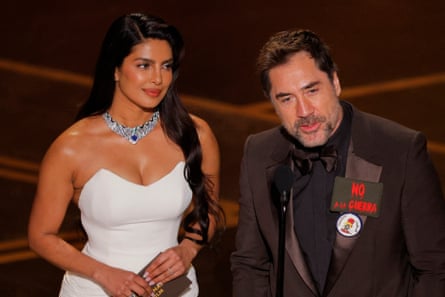
For years, it seemed to be a given that politics and Hollywood’s biggest night simply didn’t mix, despite impactful moments from Marlon Brando in 1973 (when Sacheen Littlefeather collected the best actor Oscar on his behalf) to Jonathan Glazer in 2024 (the director compared the Israel-Gaza conflict to the Holocaust). This year seemed to signal a new attitude. Here we had Javier Bardem saying “free Palestine” while presenting to whoops from the audience, Joachim Trier criticizing politicians who don’t have the next generation’s best interests at heart, and best picture winner Paul Thomas Anderson denouncing the “housekeeping mess” that we have left the world in. Judging by the reaction in the Dolby Theatre, they were far from the only ones who felt the same. Owen Myers
Big tech is a big loser
In a year when the encroachment of generative AI on Hollywood has become impossible to ignore – just ask Ben Affleck, whose furtive “film-maker focused” AI company was just bought by Netflix – there was a notable undercurrent of anti-tech resistance, or at least skepticism, coursing throughout the Oscars, starting with O’Brien’s opening joke of the telecast about being “the last human host” of the show. There were good-natured but still pointed jabs at Netflix co-CEO Ted Sarandos (“It’s his first time in a theater!”) and the futility of chopping up classics for TikTok, as well as a bit spoofing the (reported) mandate from streaming companies to keep reiterating the characters and plot for distracted, phone-addled viewers. Most pointed was Will Arnett presenting for animation, a genre many an AI professional believes can and should be fully ceded to the machine: “Tonight, we are celebrating people, not AI, because animation, it’s more than a prompt. It’s an art form and it needs to be protected.” We’ll see if the hearty cheers Arnett received for that line actually translate into meaningful action. Adrian Horton
Goodbye, Oscarbait?
Ever since the Miramax machine dominated the Oscars from the late 90s into the 00s, the idea of Oscarbait highlighted the difference between what the Academy thought was worthy and what the rest of us did. Stodgy biopics, laboured actorly transformations, ungainly adaptations, anything directed by Lasse Hallstrom … it was all a far cry from edgier winners of the past like Midnight Cowboy or The French Connection or The Lost Weekend. But the diversified Academy with more voters who are female, international and of colour, has changed our concept of what an Oscar movie now is. So in the year after Anora swept the main categories, now we’ve had One Battle After Another and Sinners win big, two daring, hard-to-define films that do not in any way represent Oscarbait. It’s not as if this year’s nominees don’t fall into that category, it’s just that voters are less likely to pick them with films like Hamnet winning just one award and Train Dreams winning zero. Benjamin Lee
Musical moments stole the show
After making a shameless ploy for gen Z viewers with a James Bond medley last year, tonight’s musical performances felt both modern and worthy of Hollywood’s biggest stage. Dancers and musicians flooded the stage in an ambitious recreation of Sinners Pierce The Veil sequence, with guests including musician Brittany Howard and ballet dancer Misty Copeland. At the center, Miles Caton and Raphael Saadiq shone through the curated chaos, which is no small feat. And while we’ve seen the Kpop Demon Hunters trio of Ejae, Audrey Nuna and Rei Ami pop up on a seeming daily basis this awards season, their performance of best original song Golden was inventive as well as deserved victory lap, with dancers gliding across the stage wearing traditional Korean hanbok. But my personal pick for musical moment of the night goes to Barbra Streisand. After a touching spoken tribute to Robert Redford, Streisand picked up the mic and sang a few bars of The Way We Were, the theme from the 1973 romance of the same name. Her voice, changed with time, seemed to give the familiar song a new kind of touching power. Owen Myers
Trust precursors over a vibe shift
It was a race that had seemed impossible to call for some and in the last few weeks, many had started to bet that Sinners was going to come out on top. Odds had improved and pundits for major publications, including our own, had put their chips on Ryan Coogler’s vampire saga to take home the top prize. The vibe shift had been largely the result of Sag’s Actor awards, which saw Sinners take the ensemble prize as well as a surprise best actor win for Michael B Jordan. But the ensemble award is rarely a surefire predictor of best picture success (previous winners have included The Trial of the Chicago 7, Hidden Figures, Black Panther, Three Billboards, American Hustle and last year Conclave), and instead, every other more reliable precursor confirmed what many had long-known: it was always going to be One Battle After Another. It had won the Golden Globe, the PGA, the DGA, the Bafta and the Critics Choice award and while the race is far less mathematically predictable as it once was, a season-long sweep is hard to ignore. Benjamin Lee
Women were central
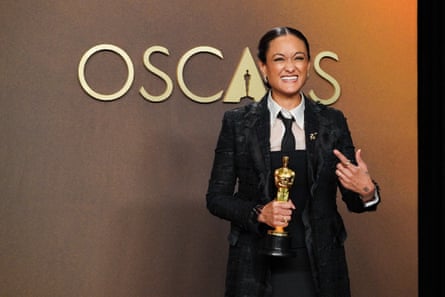
The Oscars always nod to and sentimentally celebrate the trailblazers who came before, but there was a particular resonance this year in tributes to women who broke barriers old and new, many of whom never got their flowers. There was Cassandra Kulukundis, the first-ever Oscar-winning casting director for One Battle After Another, who shouted out the many casting directors before her who never received Academy recognition. Rachel McAdams, who honored the life of the incomparable Diane Keaton and reminded: “There isn’t an actress of my generation who is not inspired by and enthralled with her absolute singularity.” Jessie Buckley, now the first Irish winner of best actress, who thanked “all the incredible women that I stand beside. I am inspired by your art and your heart, and I want to work with every single one of you.” And notably, Autumn Durald Arkapaw, the director of photography for Sinners, who became the first woman ever to win for cinematography – yes, in 2026, we are still breaking glass ceilings in major categories. “I’m so honored to be here and I really want all the women in the room to stand up because I feel like I don’t get here without you guys,” she said, in perhaps the most pointed, and generous, of many nods to female solidarity throughout the night. Adrian Horton
International features failed to break through
After strong showings for international film in recent years with Anatomy of a Fall’s original screenplay win in 2024 and four Oscars for All Quiet on the Western Front the year before, it seemed like we were due for another banner year for foreign language features. Norway’s Sentimental Value picked up nine nominations this year, while Brazil The Secret Agent was riding strong tailwinds in the wake of Wagner Moura’s Golden Globe win. Ultimately, they walked away with just one between them (best international feature for Sentimental Value, awarded to Norway), which felt like short shrift for Moura’s powerful performance as a world-weary former professor living through a dictatorship. In another year, Moura as well as Sentimental Value’s Renate Reinsve could have dominated the lead acting categories. It’s some consolation that more film fans than ever have experienced their brilliance. Owen Myers
And where was Sean Penn?
In a surprise to few, Sean Penn won for best supporting actor, for his singularly repulsive, undeniable performance in One Battle After Another. In a surprise to maybe just as few, he was not there to collect his third Oscar. (He previously won best actor twice, for Mystic River in 2004 and for Milk in 2009.) The 65-year-old actor and activist, long uncomfortable with the spotlight and ambivalent about awards season, opted to skip the ceremony, instead flying to Europe for a planned trip to Ukraine, according to two unidentified sources who spoke with the New York Times. It’s not that uncharacteristic a move for Penn, who has befriended Ukrainian president Volodymyr Zelenskyy and, more infamously, El Chapo (on assignment for Rolling Stone in 2016). The thoughts on his absence at the Dolby Theatre could perhaps best be summed up by presenter Kieran Culkin, who said with a smirk and a shrug: “Sean Penn couldn’t be here this evening, or didn’t want to, so I’ll be accepting the award on his behalf.” Adrian Horton